Let's see. Where did I leave off?
1 - 'Le Vesuve' 2 - 'Mme Abel Chatenay' 3 - 'Clotilde Soupert' #1
4 - 'Capitaine Dyel de Graville' 5 - 'Clotilde Soupert' #2 6 - 'Bow Bells' 7 - 'White Pet'
I have two 'Clotilde Soupert' bushes and one climber. It is a wonderfully performing rose in my garden. The next nine photos are of CS#2 (bush #5 in the top photo), starting at the beginning of May. 'Clotilde Soupert' is affectionately called a poly-tea because one parent is a polyantha and the other is a tea rose. That combination makes her better for my garden than a plain polyantha because they often don't like higher pH, but then I once had another beautiful poly-tea, 'Perle d'Or', that had awful chlorosis in my garden. So trial and error is often the name of the game when selecting roses.
Here she has added quite a bit of growth since the deadheading of her last bloom, and she is just starting to put on buds. She's about four feet across and high.
A few days later clusters are forming and canes are lengthening. Her foliage is just about my favorite, so healthy and plentiful.
Another view on the same day.
This is about two weeks after the first photo. You can see the canes are slender and the candelabras are getting quite long with several buds on each.
Flowers are starting to open and pretty much cover the bush. Interestingly, only some of these clusters grow from the ends of existing canes that were previously trimmed. Others like the cluster in the lower center are entirely new canes from the base or higher up along the cane. That's why this cluster sits right on the surface of the bush instead of out in the air.
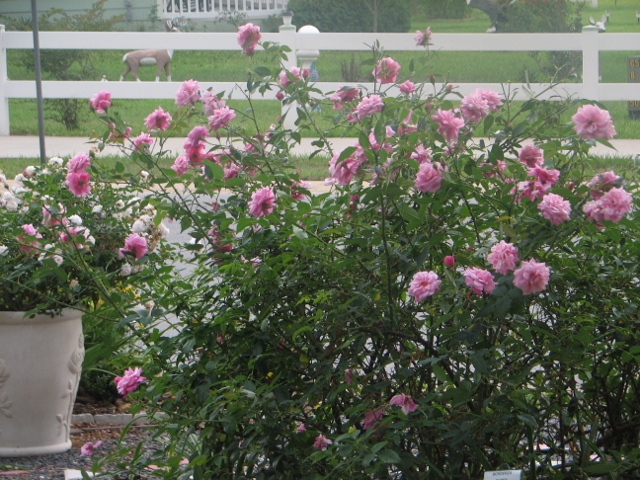
Here's her sidewalk side a little later. She's about five feet across and high. Many flowers are fully open, and everything looks fine from here.
Her flowers are really lovely and packed with petals, very heavy and dense - and fragrant.
From her back side toward the house you can see a problem on the right. Some of her candelabras are no longer standing up but have fallen over from their heavy burden.
So instead of being covered all over with flowers, she has green space, because long canes and their flowers clusters are laying down. If I remember right, we had had a heavy rain. Wet petal-packed blooms weigh a ton.
'Clotilde Soupert' is famous for balling in cooler climates in wet or even damp weather. I haven't found it to be much of a problem in my garden. I think our heat benefits her, but these buds were at their most vulnerable stage when the rain came - sepals open but petals not open. The wet outer petals are not able to flex back, so they just stay in place and turn brown. If you push the outer petals back with your fingers before too much time passes and they rot, the flowers should open pretty well. She had only a few clusters like this, due to her steady output of buds over the weeks of her bloom.
The next two photos are CS#1 (bush #3 in the top photo). She is not as round a bush as the one next to the sidewalk. A few months after she was planted I realized I had made a mistake in locating her so close to the other one, so I moved her. She really struggled after the transplant, and I was afraid I'd lose her. She went through the winter with two canes and took most of the next year to slowly recover. This year she has added some bulk, but she's oblong not round.
This photo is only of one side of the bush. They can really pump out the flowers - seemingly always with more coming.
Here's the top of her looking across at 'Le Vesuve'. One final thought - her spent clusters are easily removed with one cut by cutting at the first leaf down the cane past the candelabra. This keeps her from getting too big also. Of course, if space is in abundance in your garden, you can simply remove each spent flower, leaving the cluster stems, and she will sprout new growth in several places on that cluster. By taking off the whole cluster I remove almost a foot of length from each cane. I didn't do this during her first couple of years, giving her time to grow as nature intended her.
I guess the other bush shots will wait for Part 3. I think I found a better font. I thought the other one was pretty, but if you can't read it.... Fonts are one way my non-normal brain expresses itself.


 .
.