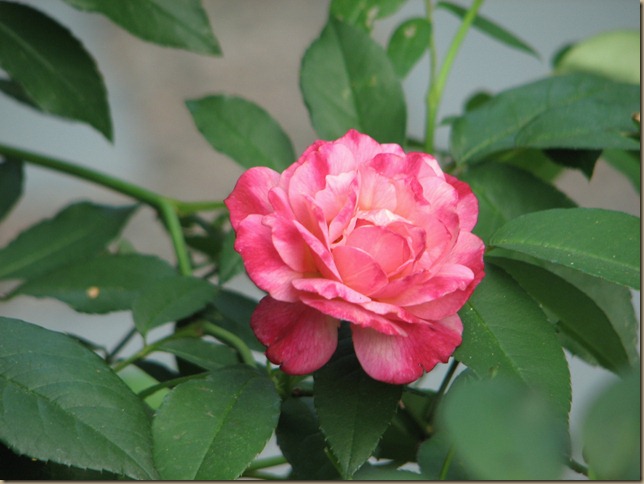
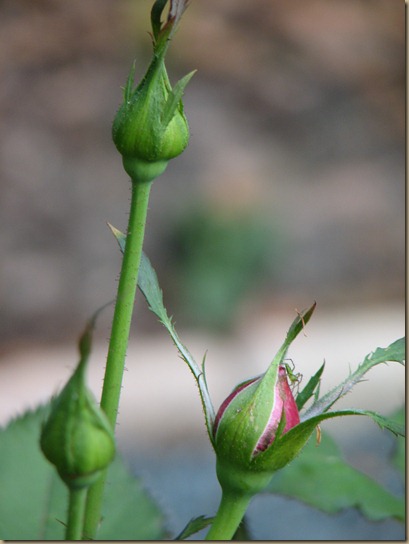
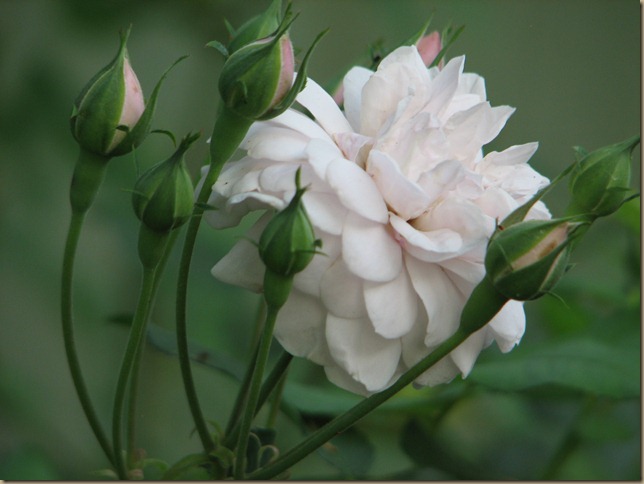
‘Clotilde Soupert’ is the early riser of the garden, up and at ‘em at the crack of dawn. Everybody else takes after the gardener for whom 8AM is really early. So it’s looking like the old clock on the garden wall is saying about 6:30, maybe quarter to seven. ‘Leonie Lamesch’ is not only awake but cheerful. She’s just off the patio, and I can see her from the back door, dotted with her small but happy red/pink/cream blossoms. She appears in the next four photos. She’s only been in the ground for about a year and only has two mature canes, so though she’s strikingly pretty, she’s not a candidate for a full bush just yet. You can guess that I love her foliage.


‘Mrs B R Cant’ is really lovely this spring compared to previous years. Being on Fortuniana rootstock, last year I followed conventional wisdom and pruned her quite hard, including removing leaves. Then last season she grew wacky with eight-foot canes sprouting from five feet high on the bush. She looked like she was trying to be a climber, but those heavy canes just flopped over and laid down on other plants. Growth was going horizontally through the bush, and she wasn’t very leafy at all. My excuse for her was that she’s growing way under two huge oaks and deprived of enough sun. So last month when I was on my pruning rounds, I could not make heads or tails of her, because she was such a jumble of confused growth. I removed most of her leaves just so I could see what was where. Then I decided to shorten all that long stuff to match the rest of the bush, remove dead stuff and downward growing stuff, and end it there. My conclusion was that last year’s pruning forced contrary growth. Of course, that’s only my observation, one admittedly influenced by my prejudice against Teas on Fortuniana.

Well, she has more leaves and is bushier this year. (She was so non-foliated last year that she was un-photographable.) See that nearly horizontal line in the middle of the bush? That’s one of those canes I mentioned before. In my experience some Teas sprout shoots at nearly right angles from the original cane, and I believe cutting exacerbates that habit, causing multiple shoots near the cut. So I’m going to see if minimal cutting helps her. I know the pros will strongly differ with me on this, but I’m just trying to achieve some normalcy for her without a clue as to what her normal really is. By the way she's about six feet tall and close to eight feet wide.

She has a lot of buds on her but has been loathe to make any cane breaks down low. None last year or this year so far.

‘Polonaise’ is looking good after this winter’s transplant. She has a good many buds already on her few canes.
‘Mary Guthrie’ surprised me yesterday with this bright flower which is exactly true-to-life color. She was relocated, too, for the sake of these scrumptious flowers. No black spot yet, the gardener said with a wry, little chuckle. HMF says she's fragrant, but dumb gardener didn't know because she has never taken a whiff!

Happily, more bright flowers are coming as seen in this photo.

In my last post you saw the red new canes of ‘Maman Cochet’. Now about nine days later they are almost green and about four feet long. Her middle is looking nicely full.

My in-the-ground ‘Borderer’ is also blooming and filled with buds. She’s quite a small bush – maybe two feet tall and four feet across.

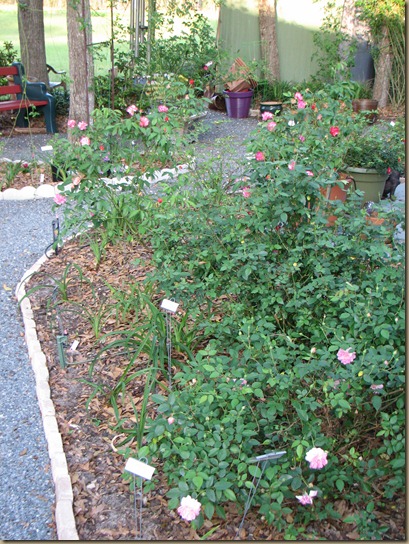
Here’s the full bed. From front to back, ‘Borderer’, ‘White Pet’, and ‘Leonie Lamesch’. ‘White Pet’ has buds but no flowers yet.
This is ‘Francois Juranville’, my rambler that cascades from the rebar arbor. This is his third season in the garden, and being a once-bloomer (though my fingers are crossed for some repeat here in sunny Florida), there were no flowers the first year and literally only a handful last year since he only blooms on old wood. This is the first flower I’ve seen this year. I chose this rambler for its fairly large and double flowers and for the color. It seems most ramblers are small-flowered and white, and you know how much I like color. See those shiny, healthy green leaves? Those are Wichurana leaves. They are the other reason I chose this rose. No black spot. An evergreen climber that would cover my vacant arbor was what I was seeking. Flowers almost didn’t matter. These will definitely be a bonus.

Here’s FJ in February. He’s been bulking up lately, throwing thick new canes all over the place. I keep trying to tuck them in so they go vertical. If allowed to go straight out from the existing verticals, I think he’d be happy to take the whole garden.

The first flower (that I’ve seen) of ‘Duchesse de Brabant’. Only a year in the ground, she’s young and flimsy, but she has at least grown in all directions and is maybe two feet tall and almost five feet wide. She’s in a cooler location than my first DdB which I think will keep her better foliated with pinker blooms. Obviously, being a Tea Rose, heat should not be a problem, but for three years I could not keep leaves on the bush from which this plant was cut. So if she’s more comfortable out of the scorching sun, it’s fine with me.

‘Blush Noisette’ has one open flower and some buds though she’s far from covered yet. She has leafed out some since the hard pruning but not a lot.
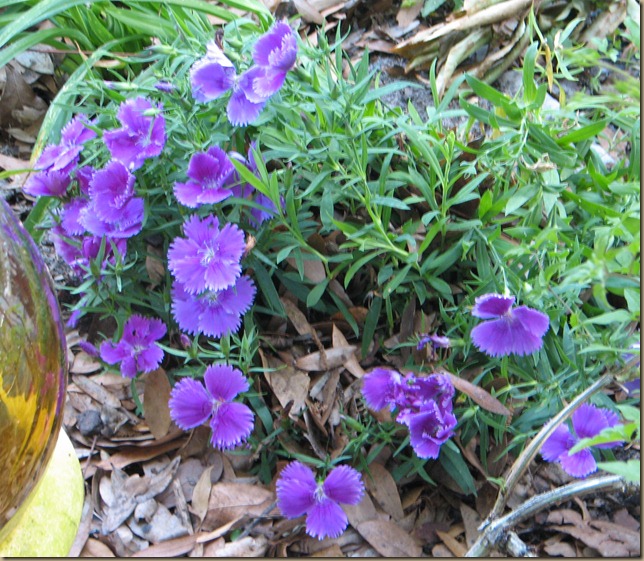
You may remember that I love Dianthus chinensis. Summer, winter, it doesn’t matter. They’re green and blooming. This is a new color that I got this winter – in fact, two of them. I love the color! Oh, wow! It just occurred to me that this one is planted at the feet of purple Clematis ‘Venosa Violacea’. Sometimes things just work out, don’t they?
I am so excited about the new scapes on several daylilies. These are the Early Season DLs, and I must admit that I didn’t realize that early meant this early. This particular one is Bob Carr’s ‘Inherited Wealth’. This is one that I am itching to see bloom. I chose it for its gorgeous and abundant flowers that I had seen in photos even though it supposedly does not rebloom. In my long, long growing season I love and demand rebloomers. So we’ll see about this one. I can always hope it will decide to bloom again, right?

Yesterday I blew the leaves out of the gravel paths, so the garden is tidier. I was feeling like a really low-down garden-keeper with all those oak leaves covering everything. They keep dropping – month after month. I hope they’re done, and I hope I can mulch them up with the lawn mower. So with the garden cleaned up and blooming, I’m almost a happy camper. If some little elves would come and spray the weeds in the front circle gravel with RoundUp, then I would be a full-fledged happy camper. This photo was taken way back in February (apparently when I was pruning), and since the weed is of great proportions, maybe I’ve already pulled it. Let’s hope so.


‘Mrs B R Cant’ is really lovely this spring compared to previous years. Being on Fortuniana rootstock, last year I followed conventional wisdom and pruned her quite hard, including removing leaves. Then last season she grew wacky with eight-foot canes sprouting from five feet high on the bush. She looked like she was trying to be a climber, but those heavy canes just flopped over and laid down on other plants. Growth was going horizontally through the bush, and she wasn’t very leafy at all. My excuse for her was that she’s growing way under two huge oaks and deprived of enough sun. So last month when I was on my pruning rounds, I could not make heads or tails of her, because she was such a jumble of confused growth. I removed most of her leaves just so I could see what was where. Then I decided to shorten all that long stuff to match the rest of the bush, remove dead stuff and downward growing stuff, and end it there. My conclusion was that last year’s pruning forced contrary growth. Of course, that’s only my observation, one admittedly influenced by my prejudice against Teas on Fortuniana.

Well, she has more leaves and is bushier this year. (She was so non-foliated last year that she was un-photographable.) See that nearly horizontal line in the middle of the bush? That’s one of those canes I mentioned before. In my experience some Teas sprout shoots at nearly right angles from the original cane, and I believe cutting exacerbates that habit, causing multiple shoots near the cut. So I’m going to see if minimal cutting helps her. I know the pros will strongly differ with me on this, but I’m just trying to achieve some normalcy for her without a clue as to what her normal really is. By the way she's about six feet tall and close to eight feet wide.

She has a lot of buds on her but has been loathe to make any cane breaks down low. None last year or this year so far.

‘Polonaise’ is looking good after this winter’s transplant. She has a good many buds already on her few canes.

‘Mary Guthrie’ surprised me yesterday with this bright flower which is exactly true-to-life color. She was relocated, too, for the sake of these scrumptious flowers. No black spot yet, the gardener said with a wry, little chuckle. HMF says she's fragrant, but dumb gardener didn't know because she has never taken a whiff!

Happily, more bright flowers are coming as seen in this photo.

In my last post you saw the red new canes of ‘Maman Cochet’. Now about nine days later they are almost green and about four feet long. Her middle is looking nicely full.

My in-the-ground ‘Borderer’ is also blooming and filled with buds. She’s quite a small bush – maybe two feet tall and four feet across.

Here’s the full bed. From front to back, ‘Borderer’, ‘White Pet’, and ‘Leonie Lamesch’. ‘White Pet’ has buds but no flowers yet.

This is ‘Francois Juranville’, my rambler that cascades from the rebar arbor. This is his third season in the garden, and being a once-bloomer (though my fingers are crossed for some repeat here in sunny Florida), there were no flowers the first year and literally only a handful last year since he only blooms on old wood. This is the first flower I’ve seen this year. I chose this rambler for its fairly large and double flowers and for the color. It seems most ramblers are small-flowered and white, and you know how much I like color. See those shiny, healthy green leaves? Those are Wichurana leaves. They are the other reason I chose this rose. No black spot. An evergreen climber that would cover my vacant arbor was what I was seeking. Flowers almost didn’t matter. These will definitely be a bonus.

Here’s FJ in February. He’s been bulking up lately, throwing thick new canes all over the place. I keep trying to tuck them in so they go vertical. If allowed to go straight out from the existing verticals, I think he’d be happy to take the whole garden.

The first flower (that I’ve seen) of ‘Duchesse de Brabant’. Only a year in the ground, she’s young and flimsy, but she has at least grown in all directions and is maybe two feet tall and almost five feet wide. She’s in a cooler location than my first DdB which I think will keep her better foliated with pinker blooms. Obviously, being a Tea Rose, heat should not be a problem, but for three years I could not keep leaves on the bush from which this plant was cut. So if she’s more comfortable out of the scorching sun, it’s fine with me.

‘Blush Noisette’ has one open flower and some buds though she’s far from covered yet. She has leafed out some since the hard pruning but not a lot.

You may remember that I love Dianthus chinensis. Summer, winter, it doesn’t matter. They’re green and blooming. This is a new color that I got this winter – in fact, two of them. I love the color! Oh, wow! It just occurred to me that this one is planted at the feet of purple Clematis ‘Venosa Violacea’. Sometimes things just work out, don’t they?

I am so excited about the new scapes on several daylilies. These are the Early Season DLs, and I must admit that I didn’t realize that early meant this early. This particular one is Bob Carr’s ‘Inherited Wealth’. This is one that I am itching to see bloom. I chose it for its gorgeous and abundant flowers that I had seen in photos even though it supposedly does not rebloom. In my long, long growing season I love and demand rebloomers. So we’ll see about this one. I can always hope it will decide to bloom again, right?

Yesterday I blew the leaves out of the gravel paths, so the garden is tidier. I was feeling like a really low-down garden-keeper with all those oak leaves covering everything. They keep dropping – month after month. I hope they’re done, and I hope I can mulch them up with the lawn mower. So with the garden cleaned up and blooming, I’m almost a happy camper. If some little elves would come and spray the weeds in the front circle gravel with RoundUp, then I would be a full-fledged happy camper. This photo was taken way back in February (apparently when I was pruning), and since the weed is of great proportions, maybe I’ve already pulled it. Let’s hope so.


