One of the knocks against rose gardening is the unappealing look of ‘soldier’ rows of bushes naked from the knees (or waist) down. I deliberately did not design my garden in rows. For one thing I didn’t have the room, and for another I was afraid my front yard would look stupid. So I wound up with circles and curves. My biggest frustration as a new gardener was all the empty space around the tiny new roses and later the unleafy state of my young bushes. So I made the decision to add companion plants in an effort to reduce the pressure to perform on the roses and on me. I figured with other stuff to look at my ugly roses wouldn’t be so noticeable. So my garden became cottage-y.
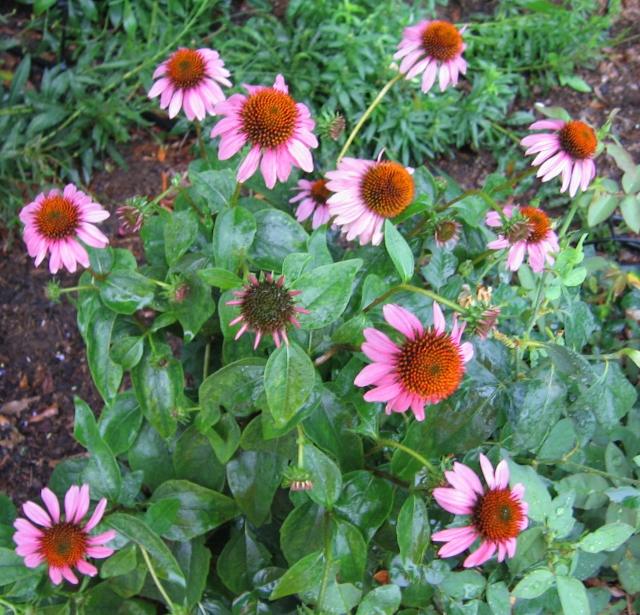
My learning curve was pretty steep. Every plant was an experiment. I learned that very few plants when placed in a watered, amended Florida garden do not become gargantuan. Plant after plant was eliminated due to their bulk in my tiny garden and the fact that the roses were filling the empty space on their own. So my cache of companions were few: Salvia farinacea, daylilies, Purple Coneflower, Dianthus chinensis, and this year dahlias. Admittedly, there are some that I haven't tried, but I got gun-shy. There are a few that reseed, returning in winter or early, early spring like nigella ‘Love in a Mist’ and larkspur, but they’re done in by the heat eventually and are gone by June.
Last year I went nuts with Purple Coneflower seeds, and when the seedlings sprouted I was so covetous of them that I barely thinned them, not realizing these babies would grow into beasts 15” in diameter (and more) with a root system even broader and reaching for China. The lovely non-rhizome-spreading Salvia farinacea is a reseeder as well but in the current season. Though easily thinned, it can fill a bed if left alone. The thrill of spring became the wonderment of mid-summer and the terror of fall.
I will be much more conservative about my companion planting in the future. Perhaps in other regions/climates where these perennials are not so robust and the soil is richer they would not pose the same threat to roses as they have in my garden. Naturally, even in Florida a larger garden would be effected less, assuming the gardener didn't get greedy (who me?) and plant too far under the roses' canopy. The daylilies do not seem to have this deleterius effect, thankfully. Perhaps I can use the pentas in pots, too, maybe even partially sinking them in the soil - or not. And maybe the restrictions of the pot will limit their size. At any rate this year has been another learning season filled with as much fretting as the previous ones - different year, different problems. I am grateful to the true Master Gardener for these opportunities to learn, and I should pray to become a better student.
My learning curve was pretty steep. Every plant was an experiment. I learned that very few plants when placed in a watered, amended Florida garden do not become gargantuan. Plant after plant was eliminated due to their bulk in my tiny garden and the fact that the roses were filling the empty space on their own. So my cache of companions were few: Salvia farinacea, daylilies, Purple Coneflower, Dianthus chinensis, and this year dahlias. Admittedly, there are some that I haven't tried, but I got gun-shy. There are a few that reseed, returning in winter or early, early spring like nigella ‘Love in a Mist’ and larkspur, but they’re done in by the heat eventually and are gone by June.
Last year I went nuts with Purple Coneflower seeds, and when the seedlings sprouted I was so covetous of them that I barely thinned them, not realizing these babies would grow into beasts 15” in diameter (and more) with a root system even broader and reaching for China. The lovely non-rhizome-spreading Salvia farinacea is a reseeder as well but in the current season. Though easily thinned, it can fill a bed if left alone. The thrill of spring became the wonderment of mid-summer and the terror of fall.
 |
| Now, the cottage gardener would love this bed, but upon hearing that there's a 4-1/2 by 6 foot rose bush in there the rose gardener would have heart failure. |
 |
| When I was taking these 'before' shots back in mid-October after my summer hiatus, I was stunned by the density of the companion plants. The liriope had become huge; the salvia with glorious abandon had spread everywhere even overtaking the Purple Coneflower plants. By the way there are three rose bushes in there. |
 |
| This is 'White Maman Cochet' no doubt struggling to breathe. |
 |
| The pulling began shyly at first. The sweet purple flower stalks were so lovely. |
 |
| Then reality hit home. If there's no light, there's no life, and I found lots of deadwood at the bottom of WMC. The short greenery is weeds. Apparently, they don't need light. The larger leaves on the right are young Purple Coneflower plants, raring to go. |
 |
| Believe it or not 'Madame Antoine Rebe' is actually blooming under that pile of companions - even the 'Aaron' caladiums gave up the fight. |
 |
| Here's the opposite angle. |
 |
| 'Souvenir de St. Anne's' was originally planted too close to 'White Maman Cochet' which was bad enough, but then the daylily grew and the coneflowers grew and she is fighting for her space. |
 |
| My attitude finally became 'take no prisoners', and I think WMC is happier already. |
 |
| She has a few blooms and buds and a very strong will. |
 |
| There are a few salvias in the middle that I didn't have the heart to pull. Maybe I'll be able to tuck them in somewhere. Kept under control they are my preferred in-the-ground companion now. |
 |
| I added more space to the back of the bed, meaning I pulled up the weed cloth, broke up the compacted sand, threw in some Sphagnum peat moss, bagged soil, Milorganite and alfalfa and trusted that liriope isn't as nutritionally demanding as roses) and moved three of the 'Super Blue' liriope along the new back line. |
 |
| I stuck coneflowers and salvias in between the liriope. I hate to throw away plants. |
 |
| Don't mean to cause eye strain, but I just had to include this near-dark last shot of the day. The Program setting on the camera made light where there was no light, but the camera just could not focus on what it couldn't see. These are the coneflower plants I salvaged. I think there are six. Several small ones were thrown away. Oh, the pain. My plan for next season is to keep them in pots and scatter them throughout the garden. Requiring a shovel and several deep cuts around the rootball, these are impossible to pull by hand. They have grand root systems. Mother Nature can be very proud. Of course, there will also be the seeds from this year that will be sprouting from now on. Must stay on top of those. |
 |
| 'White Maman Cochet' does have some new growth after last month's feeding but nowhere near what she would have had with more light and less root competition. Poor thing. |
 |
| Here is 'Madame Antoine Rebe'. She has struggled since her move to this bed in early spring but looks amazingly well considering her environment for the last few months. Unfortunately, she's one-third the size she was back in February. |
 |
| David Austin's 'Tradescant' will be planted in here soon, and 'Souvenir de St. Anne's' will be moved over. |
 |
| Overplanting with companions had its negative effects elsewhere in the garden. I believe these are six - no, seven - Penta plants put in on June 28th for fill in the 'Le Vesuve' center bed. My poor 'Le Vesuve' has had a terrible year of dieback to the extent that recently I was giving strong consideration to replacing him with 'Belinda's Dream'. |
 |
| Gone now are the Pentas. The Purple Coneflowers would have been, too, if I had had my shovel. |
 |
| This photo says a thousand words to me. Look how far the bush extends past the right edge (rear) of the bed, and look how far away from the front edge he grew - or rather didn't grow. He did try to put on new growth, but most of it died. Those pentas were just sucking up the nutrients and pushing back the rose's toes |
 |
| Here's a shot from the other side. You can see there's not much bush on the right side, and look at that huge clump of coneflowers. Not thinning seedlings to one individual is a dereliction of a Florida gardener's duty. Companions are lovely, but roses come first. |
 |
| This photo from directly behind and back near the house shows that 'Le Vesuve' is a very one-sided bush. The left side even extends beyond the photo frame. How sad for him, but at least he survived. Roses really are tough. |
 |
| And this June 28th photo says it all! 'Le Vesuve' was a balanced bush back then with many more canes than today. However, his decline had already started on the left side due to the coneflower plants, I'm sure. I only added to his problems with the addition of the pentas. Apparently, the salvia on the right is a less intrusive plant and less demanding of nutrients than the coneflowers and the pentas which grew to almost three feet tall. I'll be putting daylilies back along the edges. |
I will be much more conservative about my companion planting in the future. Perhaps in other regions/climates where these perennials are not so robust and the soil is richer they would not pose the same threat to roses as they have in my garden. Naturally, even in Florida a larger garden would be effected less, assuming the gardener didn't get greedy (who me?) and plant too far under the roses' canopy. The daylilies do not seem to have this deleterius effect, thankfully. Perhaps I can use the pentas in pots, too, maybe even partially sinking them in the soil - or not. And maybe the restrictions of the pot will limit their size. At any rate this year has been another learning season filled with as much fretting as the previous ones - different year, different problems. I am grateful to the true Master Gardener for these opportunities to learn, and I should pray to become a better student.